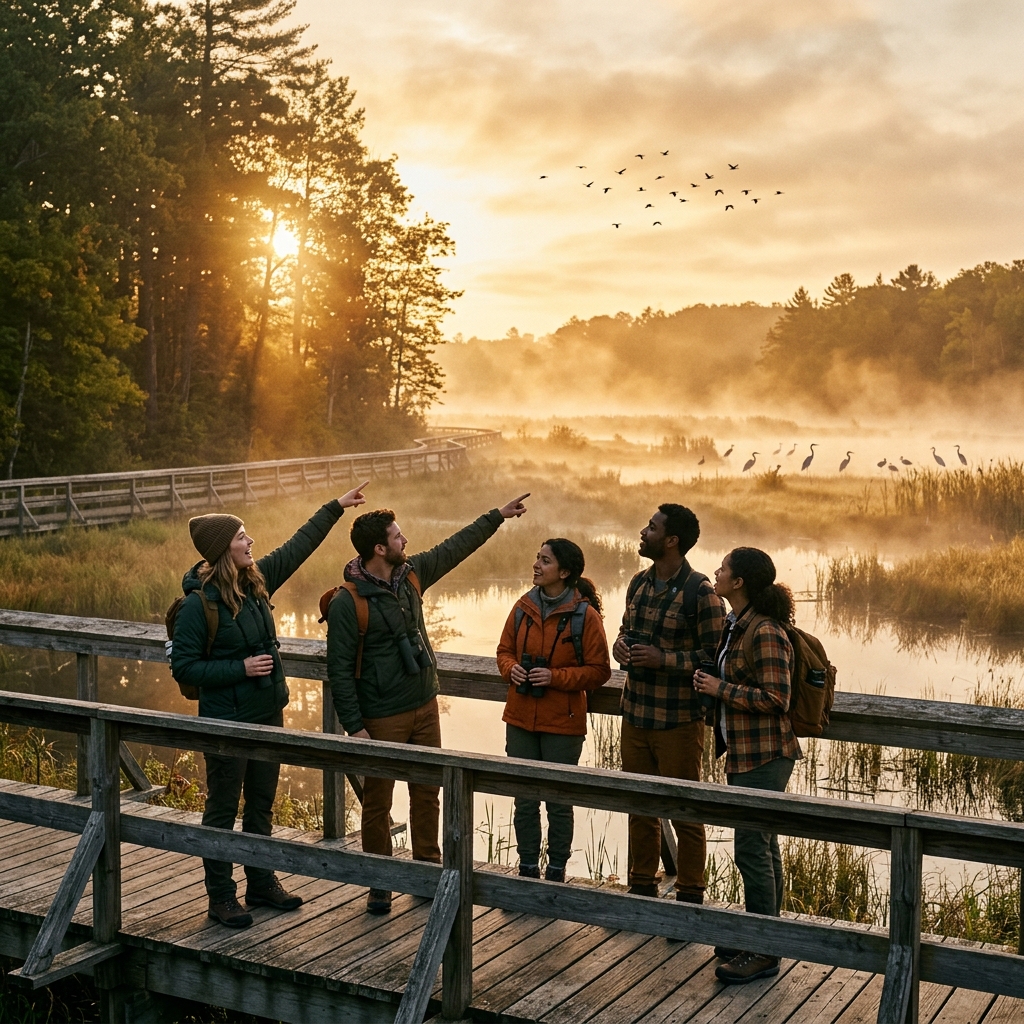
There's a specific feeling every birder knows: scrolling through eBird alerts, seeing a Painted Bunting reported two counties over, and thinking "I need to be there." But between the impulse and the field, there's a gap — logistics, timing, gear, and often, coordinating with other people who want to come along.
This guide walks through every step of planning a birding trip, whether it's a solo dawn outing to a local hotspot or a week-long group expedition during peak migration. By the end, you'll have a repeatable system for turning any birding idea into a well-executed trip.
Step 1: Pick Your Target — Species, Season, or Place
Every great birding trip starts with one of three anchors:
- A target species — You want to see a Snowy Owl, a Painted Bunting, or a Kirtland's Warbler. The species dictates the location and season.
- A season — Spring migration (April–May) and fall migration (August–October) are the highest-volume windows. Winter birding concentrates species around remaining water and food.
- A place — You're visiting Cape May, the Texas coast, or Acadia and want to maximize your birding while there.
If you're new to trip planning, start with season + place. Pick a destination known for strong birding during the month you're available. Our guide to the best birding destinations in the US is a good starting point.
Pro Tip: The 2-Week Rule
Migration timing shifts by roughly 1–2 weeks depending on latitude and weather patterns. If you're targeting spring warblers at Magee Marsh, aim for the second week of May — but build flexibility into your dates. Check eBird's "Recent Notable Observations" for your destination county starting 2 weeks before your trip to track what's arriving.
Step 2: Research Your Destination
Once you've picked a destination and rough dates, go deep on research. The difference between a good birding trip and a great one is almost always preparation.
eBird Explore
eBird's Explore feature is the single most valuable research tool for birding trips. For any location, you can see:
- Recent Notable Observations — What's been seen in the last 7–30 days
- Hotspot maps — The most birded locations near your destination, ranked by species count
- Bar charts — Which species are present in which months, so you know exactly what to expect
Local Birding Groups
Search Facebook for "[destination] birding" groups. Local birders post real-time sightings, trail conditions, and warnings about closures or construction. They're also the best source for under-the-radar spots that don't show up on eBird hotspot maps.
Weather and Conditions
Birds respond to weather more than calendars. A cold front pushing through during fall migration can produce a "fallout" — hundreds of warblers dropping into a small area overnight. Monitor weather patterns starting a week before your trip and be ready to adjust your itinerary.
Step 3: Build Your Itinerary
A strong birding itinerary isn't just a list of places — it's sequenced around the time of day, the habitat, and the species you're targeting.
The Dawn Priority
The first two hours after sunrise are when 80% of songbirds are most vocal and active. Your best hotspot should be your first stop. Save lakes, shorelines, and raptor watching for midday when songbird activity drops but waterfowl and soaring birds pick up.
A Sample Day Structure
| Time | Activity | Target |
|---|---|---|
| 5:30 AM | Arrive at primary hotspot | Songbirds, warblers, thrushes |
| 8:00 AM | Move to secondary woodland trail | Woodpeckers, flycatchers |
| 10:30 AM | Wetland or shoreline stop | Shorebirds, herons, waterfowl |
| 12:00 PM | Lunch break / rest | Review checklist, charge devices |
| 2:00 PM | Open fields or hawk watch | Raptors, grassland species |
| 5:00 PM | Return to dawn hotspot or new spot | Evening chorus, owling at dusk |
Don't Over-Schedule
The biggest mistake in birding trip planning is cramming too many stops into one day. A single productive hotspot can easily fill 3 hours. Budget 2–3 stops maximum per day, with buffer time for unexpected sightings. The best bird of the trip is almost always the one you weren't looking for.
Step 4: Pack Right
Overpacking slows you down. Underpacking means missed opportunities. Here's the field-tested essentials:
The Non-Negotiables
- Binoculars — 8x42 for woodland, 10x42 for open water and grassland. If you only own one pair, go 8x42.
- Field guide or app — Merlin Bird ID (free, with Sound ID) or Sibley Guide. Ideally both.
- eBird on your phone — Log as you go. Your future self will thank you.
- Notebook and pen — For quick sketches and behavior notes that don't fit in an app.
The Comfort Upgrades
- Layers — Dawn is cold, even in May. A packable down layer and a rain shell cover 90% of conditions.
- Insect repellent — Non-negotiable for wetlands and forests from April through October.
- Camera with a zoom lens — Even a bridge camera with 50x zoom can produce ID-quality shots for tricky species.
- Portable charger — Sound ID and GPS drain batteries fast.
- Snacks and water — You'll be on your feet for hours. Don't let hunger cut a productive morning short.
For a complete gear breakdown, see our Essential Birdwatching Gear guide.
Step 5: Coordinate Your Group
Solo birding is meditative. Group birding is productive — more eyes, more ears, more species spotted. But group trips fall apart without coordination.
The Common Failure Modes
- "What time are we leaving?" — Ambiguity about departure time means someone is always late and the group misses dawn.
- "Who's driving?" — Carpooling logistics get messy with 4+ people and different comfort levels.
- "Where are we meeting for dinner?" — Non-birding logistics eat into planning time and cause friction.
- "Wait, I thought you booked the cabin" — Accommodation gaps discovered the week before departure.
What Actually Works
The groups that have the best birding trips treat logistics like a project. Someone owns the itinerary. Someone owns lodging. Someone owns food. And everyone agrees on the wake-up time before the trip — not the night before at 11 PM.
The best approach we've seen is using a shared trip planning tool where everyone can see the schedule, vote on activities, and handle their own logistics within a shared framework. No more group text chaos.
From Our Friends at All About The Woods
Plan your next birding trip with the group — without the group text chaos
All About The Woods is a free trip planning platform built for outdoor groups. Create a trip, invite your birding crew, and coordinate everything — itinerary, lodging, carpooling, and gear lists — in one place. No app download required.
Step 6: In the Field — Maximize Every Hour
You've arrived. The research is done, the bags are packed, and it's 5:15 AM. Here's how to make the most of every hour in the field.
Listen Before You Look
When you arrive at a hotspot, stand still for 2–3 minutes before walking. Close your eyes and listen. You'll pick up species you'd never spot visually — especially warblers high in the canopy, rails in dense marsh, and owls at dusk. If you have Merlin's Sound ID running, let it capture the soundscape while you focus your binoculars.
Work the Edges
The highest bird diversity is almost always at habitat edges — where forest meets meadow, where marsh meets upland, where a creek enters a lake. Position yourself at these transitions and scan methodically.
Log Everything
Submit your eBird checklists in real-time or at each stop. Include effort (time and distance), not just species. Your data contributes to citizen science and builds a personal archive of every trip you've ever taken. Years from now, you'll be able to pull up exactly what you saw at Magee Marsh on May 12, 2026.
Step 7: After the Trip — Review and Plan the Next One
The best birders treat every trip as preparation for the next one.
Post-Trip Review
- What did you miss? Check eBird for species reported at your locations during your dates that you didn't see. Were you at the wrong spot at the wrong time, or did you just miss it?
- What worked? Which hotspot delivered? Which time of day was most productive? Note this for next time.
- Update your life list — If you use a Life List Logbook, update it while the memories are fresh.
Start a Trip Wishlist
Keep a running list of trips you want to take. When you see a rare bird alert, a migration forecast, or a friend mentions a hotspot, add it to the list with the ideal month. When a window opens in your calendar, you'll already have options ready.
Plan Your Next Trip
Turn your birding wishlist into an actual trip
Whether it's a solo weekend chase or a full group expedition, All About The Woods makes group trip planning simple. Create a trip in 30 seconds, invite your crew, and let everyone contribute to the itinerary. It's free and built for exactly this.
The Quick-Reference Checklist
Pin this to your fridge or save it to your phone:
| Step | Action | Timeline |
|---|---|---|
| 1 | Pick target species, season, or destination | 4–8 weeks out |
| 2 | Research eBird hotspots, bar charts, local groups | 3–4 weeks out |
| 3 | Build itinerary (dawn priority, 2–3 stops/day) | 2–3 weeks out |
| 4 | Pack gear, charge devices, print backup checklist | Night before |
| 5 | Coordinate group logistics (time, transport, lodging) | 1–2 weeks out |
| 6 | Execute in the field — listen, work edges, log everything | Trip day |
| 7 | Review eBird data, update life list, add to wishlist | Within 48 hours |
The best birding trips aren't lucky — they're planned. And the more trips you plan, the faster and more intuitive the process becomes. Start with the next available weekend, pick a hotspot within driving distance, and go. The birds are already there.
Ready to plan your next birding trip?
Use All About The Woods to coordinate your group, build an itinerary, and handle logistics — so you can focus on the birds.
💬 Discussion
Loading comments...
Enter your name and email to join the discussion