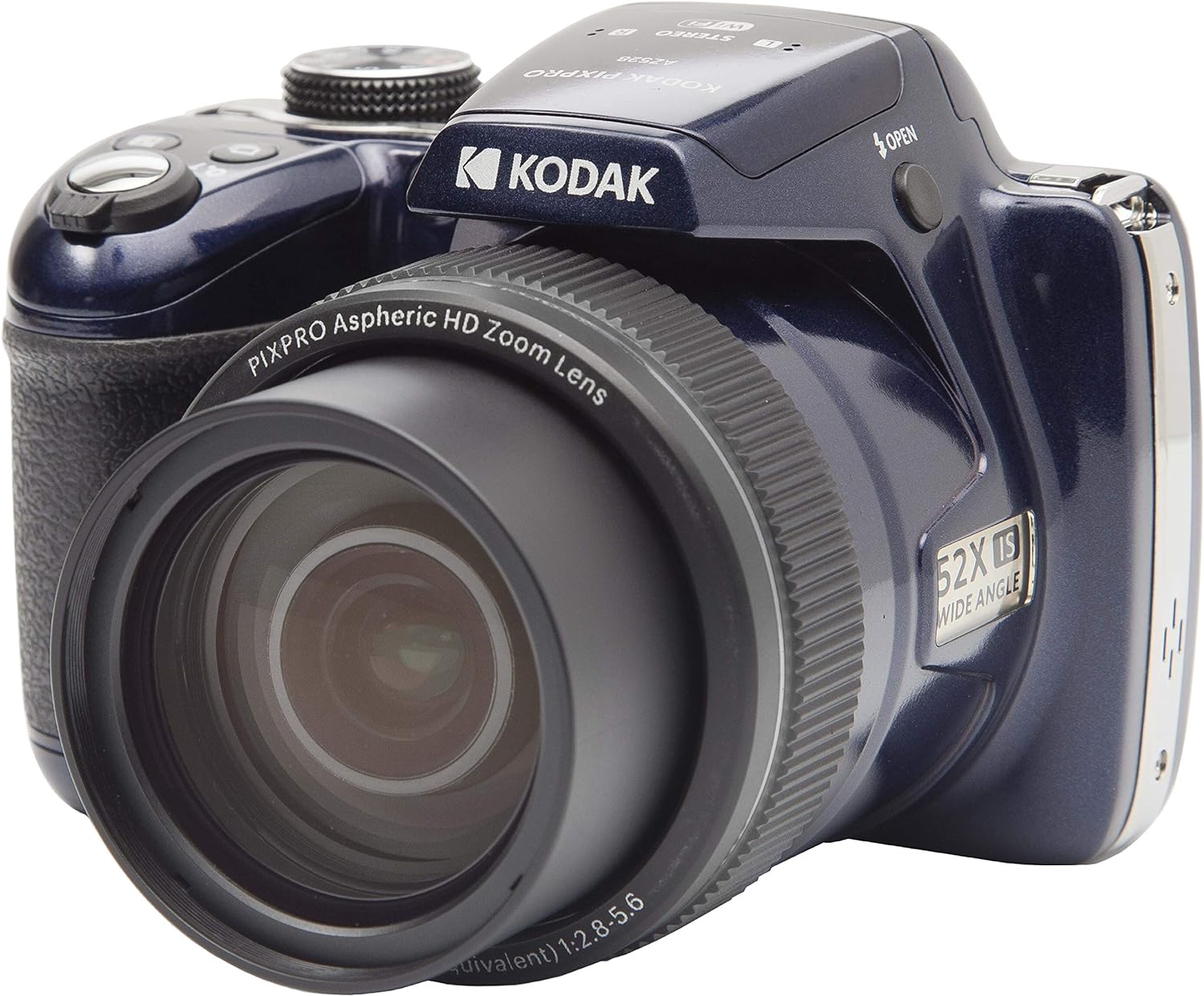
⚡ Quick Verdict
Rating: 3.5 / 5 for bird photography. The AZ528 is the cheapest way to get usable bird photos. Its 52x zoom (1248mm equivalent) gives you more telephoto reach than some interchangeable-lens setups costing five times as much. But the small 1/2.3" sensor, contrast-detect autofocus, and JPEG-only output mean you're making real compromises. If you're in good daylight shooting stationary birds, it's surprisingly capable. If you're chasing birds in flight in overcast conditions, you'll be frustrated.
Best for: Beginners, backyard birders, travel birding in good light. Not for: Birds in flight, low light, anyone who needs RAW files.
📊 Full Specifications
| Sensor | 1/2.3" BSI CMOS — 16.35 effective megapixels |
| Optical Zoom | 52x (24–1248mm equivalent in 35mm terms) |
| Digital Zoom | 4x (up to 208x combined — not recommended) |
| Autofocus | Contrast-detect AF |
| Burst Rate | 6 fps at full resolution · 30 fps at 4MP · 60 fps at VGA |
| Image Stabilization | Optical Image Stabilization (OIS) |
| ISO Range | ISO 100–3200 |
| Video | 1080p Full HD at 30 fps (no 4K) |
| Screen | 3.0" LCD — no electronic viewfinder |
| File Format | JPEG only (Exif 2.3) — no RAW support |
| Connectivity | Built-in Wi-Fi (iOS/Android remote & transfer) |
| Battery Life | ~240 shots per charge (lithium-ion) |
| Weight | ~508g (about 1.12 lbs) body only |
| Weather Sealing | None |
| Storage | SD / SDHC / SDXC card |
🔭 The Zoom: 1248mm for Under $300
Let's start with the reason this camera exists in the birding world: the zoom. The AZ528 covers 24mm to 1248mm equivalent — that's 52x optical zoom built into a lens that's permanently attached to the body. To put that in perspective: the Canon R7 with a Sigma 150-600mm lens — a very popular interchangeable-lens birding setup — gives you 960mm equivalent reach and costs about $2,300 total. The Kodak gives you 1248mm for $300.
Now, zoom reach and image quality are very different things. That Canon R7 setup produces images in an entirely different league. But if you're at a local pond photographing a Great Blue Heron that's 50 metres away, the Kodak AZ528 will get you a recognizable, frame-filling shot where a smartphone would give you a grey-blue smudge. That's not nothing.
The camera also has a 4x digital zoom (combined 208x), but we'd strongly recommend ignoring it. Digital zoom is just cropping with extra marketing. At 52x optical, you're already pushing the limits of what this sensor can resolve. Beyond that is pixel soup.
🎬 See It in Action
Video courtesy of YouTube. See the AZ528's 52x zoom in real-world wildlife use.
📷 Sensor & Image Quality: The Hard Truth
The AZ528 uses a 1/2.3" BSI CMOS sensor — the same size found in most smartphones and action cameras. For context, the APS-C sensor in a Canon R7 is about 13x larger in surface area. Sensor size directly determines how much light the camera collects, which determines noise performance, dynamic range, and how well it handles anything other than bright daylight.
In practice, this means the AZ528 is a good-light camera. In bright, sunny conditions — the golden hours of birding — it can produce genuinely usable 16-megapixel images. Colours are reasonably accurate, detail at moderate zoom levels (up to about 30x) is decent, and the built-in Optical Image Stabilization helps keep things sharp.
Push above ISO 400, though, and noise becomes very visible. ISO 800 is borderline. ISO 1600–3200 produces images that are acceptable for species identification but not for printing or close examination. The camera shoots JPEG only — no RAW — so you can't recover detail in post-processing the way you can with a RAW-capable camera.
Our take: If you're photographing birds for your eBird checklist, social media posts, or personal documentation, the image quality in good light is perfectly adequate. If you're trying to sell prints or enter photography competitions, it's not the right tool.
🎯 Autofocus: The Biggest Weakness
This is where the price gap shows most clearly. The AZ528 uses contrast-detect autofocus — the older, slower type that hunts back and forth to find focus. Modern mirrorless cameras (Canon R7, Sony A9 III) use phase-detect AF with AI bird tracking that locks onto a bird's eye and follows it through the frame. The AZ528 has none of that.
For stationary birds — a hawk on a fencepost, a duck floating on a pond, a songbird perched on a feeder — the AF works well enough if you give it a moment to lock on. For birds in flight, your keeper rate (the percentage of sharp, usable shots) will be low. Very low.
Tip: Pre-focus on a branch or perch where you expect a bird to land. When it lands, half-press the shutter to confirm focus, then fire. This "ambush" technique works far better than trying to track a moving bird with this camera's AF system.
⚡ Burst Rate: 6 fps — Decent on Paper
The AZ528 shoots at 6 frames per second at full 16MP resolution, with faster options at reduced resolution: 30 fps at 4MP and 60 fps at VGA (640x480). Six fps isn't bad — it's faster than many entry-level DSLRs from a few years ago.
The problem is that burst rate without accurate tracking AF is like a machine gun without a scope. You can fire a lot of frames, but if the autofocus isn't locking onto the bird reliably at 52x zoom, most of those frames will be slightly out of focus. The 6fps stat sounds good on paper, but the real-world keeper rate for birds in flight is still low because the bottleneck is the contrast-detect AF, not the frame rate.
👤 Who is this camera actually for?
💡 Field Tips for the AZ528
1. Use a tripod or monopod at max zoom
At 1248mm equivalent, even tiny hand tremors cause blur. The built-in OIS helps, but a tripod or bracing against a tree makes a dramatic difference in sharpness at full zoom.
2. Stay below ISO 400
The small 1/2.3" sensor struggles with noise above this threshold. Shoot in the morning or afternoon golden hours when light is strong. If you must raise ISO, stay at 800 max.
3. Pre-focus and wait
Don't chase birds with the autofocus. Focus on a perch, branch, or area where birds are active. Wait for the bird to enter your pre-focused zone, then fire.
4. Avoid digital zoom entirely
The 4x digital zoom just crops the image. Use only the 52x optical zoom. If the bird is too far at 52x, it's too far for this camera — move closer.
5. Shoot at 30–40x for the sharpest results
The lens is sharpest in the middle of its zoom range. At full 52x the resolving power drops. If you can get close enough, backing off to 30–40x produces noticeably sharper images.
📐 How It Compares
| Camera | Price | Reach | Sensor | AF |
|---|---|---|---|---|
| Kodak AZ528 | ~$270 | 1248mm | 1/2.3" | Contrast-detect |
| Nikon P950 | ~$800 | 2000mm | 1/2.3" | Contrast-detect |
| Canon R7 + Sigma 150-600mm | ~$2,300 | 960mm | APS-C | Phase-detect AI bird tracking |
| Sony A9 III + 200-600mm | ~$8,500 | 900mm | Full-frame | Phase-detect AI bird tracking |
See our full comparison in Best Cameras for Bird Photography 2026: 6 Tested & Ranked.
🎯 The Bottom Line
The Kodak PIXPRO AZ528 is the answer to a very specific question: "Is bird photography for me?" It costs $300, weighs about a pound, and reaches 1248mm. It won't compete with a Canon R7 or Sony A9 III — but it doesn't have to. It's the cheapest way to find out if you love pointing a camera at birds before spending thousands on gear you might not use.
If six months from now you're still at it, you'll outgrow it — and you'll know exactly which features matter to you when you upgrade. That's $300 well spent on education.
❓ Frequently Asked Questions
📚 Related Guides
💬 Discussion
Loading comments...
Enter your name and email to join the discussion