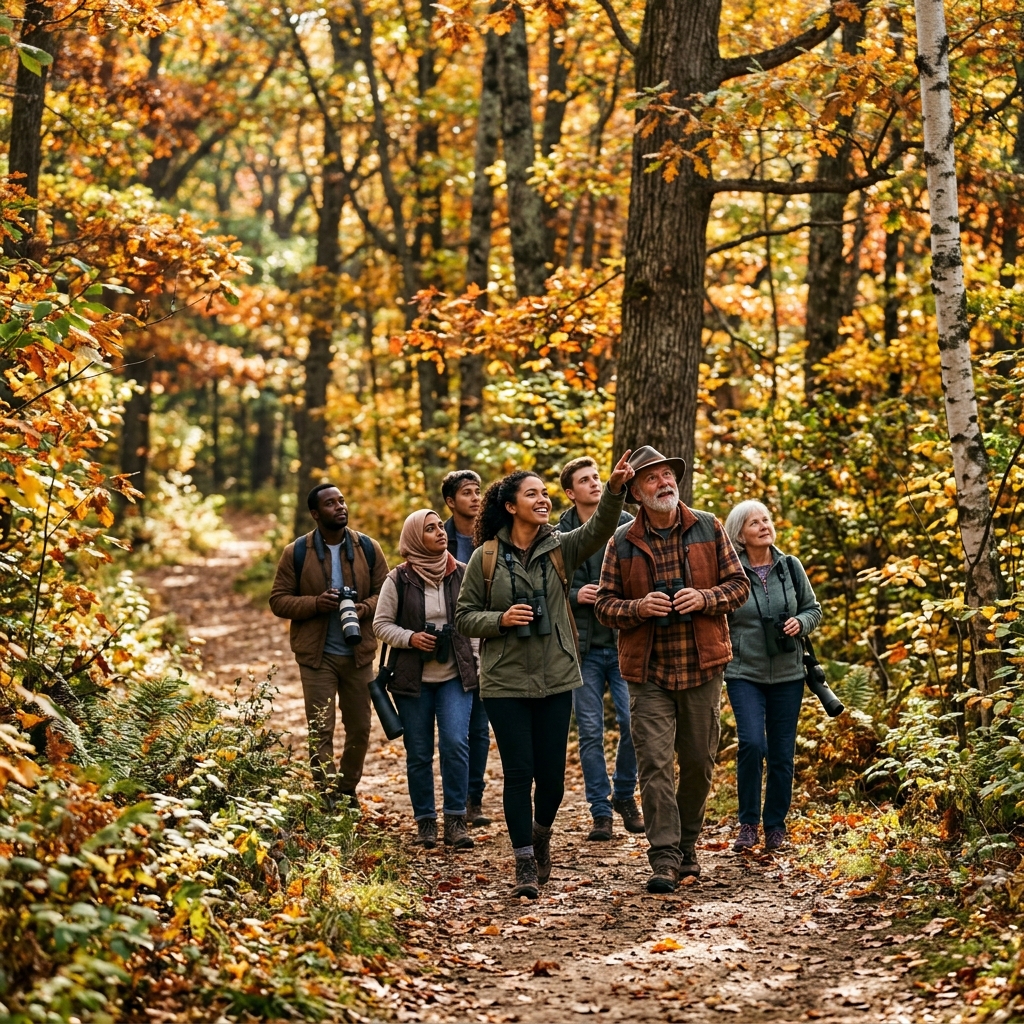
Why Birdwatching Is the Fastest-Growing Outdoor Hobby
Birdwatching — or "birding" — attracts an estimated 96 million participants in the United States alone. It requires minimal gear, can be done anywhere from your backyard to a remote rainforest, and rewards patience with unforgettable moments of natural beauty.
Essential Gear for Beginners
Binoculars: Your Most Important Investment
A quality pair of binoculars is the single most important piece of birding equipment. Here's what to look for:
- Magnification: 8x42 is the standard recommendation for beginners. The "8x" means 8 times magnification; "42" is the lens diameter in millimeters.
- Field of view: Wider is better for finding birds quickly. Look for 350+ feet at 1,000 yards.
- Budget range: $150–$300 gets you excellent quality. The Nikon Monarch M5 8x42 and Celestron Nature DX 8x42 are outstanding beginner options.
- Avoid: Anything under $50, zoom binoculars, or magnification above 10x (too shaky without a tripod).
Field Guide
Choose ONE field guide and learn it well:
- The Sibley Guide to Birds (North America) — gold standard for illustrations
- Merlin Bird ID app (free, global) — uses AI to identify birds by photo or sound
- eBird app (free, global) — log sightings and find hotspots near you
Other Essentials
- Comfortable walking shoes
- Neutral-colored clothing (avoid white and bright colors)
- A notebook for recording sightings
- Sunscreen and a hat
How to Identify Birds: The Four Keys
Professional birders use four primary identification cues, remembered as S-S-B-H:
1. Size and Shape
Compare the mystery bird to a known reference species:
- Is it sparrow-sized, robin-sized, crow-sized, or goose-sized?
- Is it stocky or slender? Does it have a long tail? A crest?
2. Sound
Bird calls and songs are often more reliable than visual identification:
- Use the Merlin app's Sound ID feature to identify songs in real-time
- Start by learning 5 common species in your area by sound
3. Behavior
How a bird moves tells you a lot about its identity:
- Does it hop or walk? Woodpeckers climb vertically. Nuthatches go headfirst down.
- Does it soar or flap? Hawks soar; falcons flap rapidly.
- Does it forage on the ground, in bushes, or high in the canopy?
4. Habitat
Where you see a bird narrows down the possibilities enormously:
- Marsh birds stay near water. Forest warblers stay in trees.
- Knowing the habitat eliminates 80% of possibilities before you even raise your binoculars.
Where to Find Birds
Your Backyard
- Set up a bird feeder with black-oil sunflower seeds (the universal favorite)
- Add a birdbath — water attracts more species than food
- Plant native shrubs that produce berries
Local Parks and Trails
- Use eBird's "Explore Hotspots" feature to find the best local spots
- Visit at dawn (birds are most active in the first 2 hours of daylight)
- Walk slowly and pause frequently — rushing flushes birds away
Beyond: Birding Destinations
Once you're hooked, consider visiting established birding destinations. AvianScope's region guides cover 46 world-class destinations with hotspot maps and seasonal advice.
Your First Month Action Plan
- Week 1: Download Merlin Bird ID. Learn 5 birds in your yard by sight and sound.
- Week 2: Visit a local park at dawn. Use eBird to find a hotspot within 30 minutes of home.
- Week 3: Start a life list. Record every new species you identify with date and location.
- Week 4: Join a local bird walk (check your local Audubon chapter or bird club).
Common Beginner Mistakes
- Chasing rare birds before learning common ones. Master your local sparrows, finches, and warblers first.
- Buying expensive optics too soon. Start with $150–$300 binoculars. Upgrade after your first year.
- Ignoring sound. Over half of all bird identifications in dense habitat are made by ear alone.
- Birding only in spring. Every season offers different specialties — winter brings owls and northern finches.
Find your perfect birding location next
Use our smart planner to discover the best spots matched to your experience level and the birds you want to see.