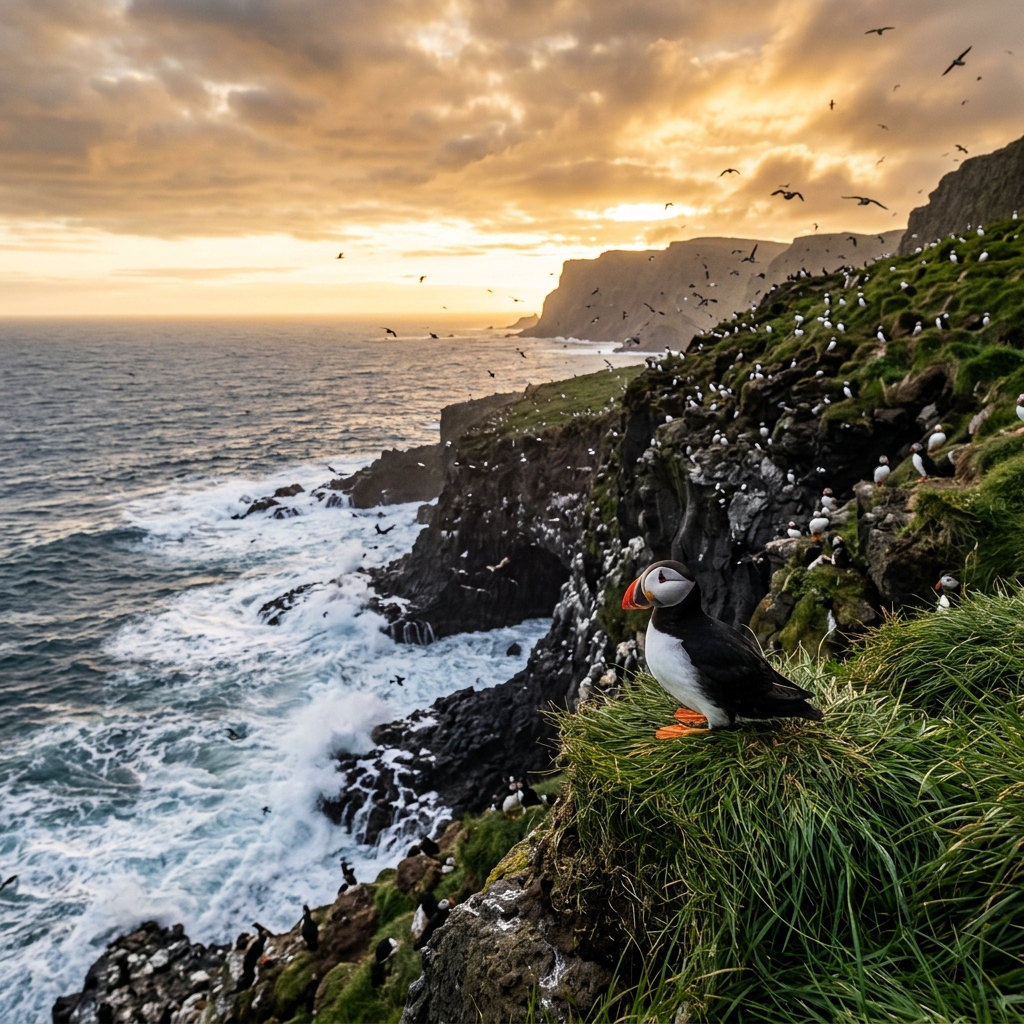
Overview
The Atlantic Puffin (Fratercula arctica) is one of the most recognizable and beloved seabirds in the world. With its colorful bill, upright posture, and comically earnest expression, the puffin has become an icon of northern coastal ecosystems. But behind the charm lies a remarkable oceanic athlete that spends most of its life at sea.
Identification
- Size: 28–30 cm (11–12 in) long; wingspan 47–63 cm
- Weight: 310–500 g
- Bill: Large, triangular, and vividly colored with red, orange, and blue-gray plates during breeding season. In winter, the bill is smaller and duller.
- Plumage: Black upperparts, white underparts, and a distinctive white face with dark eye patches
- Feet: Bright orange-red webbed feet, used for steering underwater
- Similar species: Can be confused with Razorbills at distance, but the puffin's colorful bill and rounded head are diagnostic
Biology and Behavior
Feeding
Puffins are pursuit divers, using their wings to "fly" underwater at depths up to 60 meters. Their primary prey includes:
- Sand eels (sand lance) — the staple food
- Herring and sprat
- Small crustaceans and squid
A puffin can carry 10–20 fish crosswise in its bill at once, thanks to backward-facing spines on the roof of its mouth and tongue.
Breeding
- Season: April to August (varies by latitude)
- Nest: Burrows dug into grassy clifftop soil, typically 70–110 cm deep
- Clutch: Single white egg
- Incubation: 39–45 days, shared between both parents
- Fledging: Chick (called a "puffling") leaves the burrow at night after 38–44 days, flying to sea alone
Lifespan
Puffins can live 20–30 years. The oldest recorded wild Atlantic Puffin was at least 36 years old, ringed on the Farne Islands in the UK.
Conservation Status
The Atlantic Puffin is classified as Vulnerable by the IUCN. The global population is estimated at 12–14 million individuals, but numbers have declined significantly since the 1990s due to:
- Climate change: Warming ocean temperatures shift sand eel populations away from breeding colonies
- Overfishing: Competition for the small fish that puffins depend on
- Invasive predators: Rats and cats on breeding islands
- Pollution: Plastic ingestion and oil spills
Iceland holds the largest colony (about 60% of the world population), and Icelandic populations have declined by approximately 40% since 2005.
Where to See Atlantic Puffins
Iceland
- Látrabjarg Cliffs — westernmost point of Europe, millions of puffins
- Vestmannaeyjar (Westman Islands) — largest puffin colony in the world
- Borgarfjörður Eystri — intimate viewing at arm's length
- Best months: May to mid-August
United Kingdom
- Farne Islands, Northumberland — boat trips from Seahouses; very close encounters
- Skomer Island, Wales — walk among nesting puffins on maintained paths
- Fair Isle, Scotland — remote but rewarding; seabird spectacular
- Best months: April to late July
Norway
- Runde Island — accessible colony with 100,000+ pairs
- Svalbard — High Arctic puffin colonies amid dramatic glacier scenery
- Best months: Late May to July
North America
- Machias Seal Island, Maine — the only regularly accessible colony in the eastern US (limited permits)
- Elliston, Newfoundland — "Puffin Capital of North America" with cliff-edge viewing platforms
- Best months: June to early August
Photography Tips
- Use a 100-400mm lens. On accessible colonies like Skomer or Borgarfjörður, puffins approach within 3 meters. A 400mm lens fills the frame nicely.
- Shoot at eye level. Lie flat on the ground if possible — this creates intimate, professional-quality images.
- Capture the fish carry. Position yourself between the sea and the colony to photograph adults returning with beakfuls of fish.
- Be patient. Puffins are creatures of routine. Find a well-used landing spot and wait.
Find your perfect birding location next
Use our smart planner to discover the best spots matched to your experience level and the birds you want to see.