The 7 Best Places for Birdwatching in the US in 2026
Whether you're a lifelong lister or planning your first birding trip, the United States offers some of the most extraordinary birdwatching destinations on the planet. With over 900 species on the ABA checklist and habitats spanning Arctic tundra, subtropical swamp, desert sky islands, and Pacific coast headlands, the challenge isn't finding great birding — it's choosing where to go first.
We've done the work for you. Based on species diversity, seasonal spectacle, accessibility, and the quality of the experience, here are the seven best birdwatching destinations in the United States for 2026.
1. Cape May, New Jersey — North America's Birding Capital
Best time to visit: September–November (fall migration) or May (spring) Target species: Peregrine Falcon, Merlin, Black-throated Blue Warbler, 400+ species annually
Cape May sits at the southern tip of the New Jersey peninsula, funneling billions of migrating birds into a narrow land point before they must cross Delaware Bay. The result is one of the most concentrated wildlife spectacles on Earth.
Each autumn, the Cape May Hawk Watch counts tens of thousands of raptors in a single day. Spring warbler fallouts — when cold fronts ground birds overnight into the trees of South Cape May Meadows — are events that dedicated birders plan years in advance.
Where to bird:
- Cape May Point State Park — hawk watch platform, freshwater ponds, beach
- South Cape May Meadows — shorebirds, sparrows, warblers
- Higbee Beach WMA — epic morning passerine fallouts in fall
- Cape May Bird Observatory — guided walks, ID workshops, rare bird alerts
Practical tip: Book accommodation 3–4 months ahead for peak October. The CMBO runs guided walks daily during migration — expert-led and highly recommended for first-time visitors.
2. Texas Gulf Coast & High Island — The Greatest Spring Fallout on Earth
Best time to visit: Late April–early May Target species: Cerulean Warbler, Prothonotary Warbler, Painted Bunting, 250+ species in a single weekend
High Island is a tiny town on Texas's Gulf Coast that perches on a slight elevation — a wooded oasis in an otherwise flat barrier coast. When trans-Gulf migrants hit headwinds or storms and can't complete their Yucatán-to-US crossing, they drop into the first trees they see. High Island's small woodlots fill overnight with thousands of exhausted, brilliant warblers, tanagers, and orioles feeding within arm's reach.
Where to bird:
- Boy Scout Woods — the main fallout hotspot; legendary in the birding world
- Bolivar Flats Shorebird Sanctuary — shorebirds, terns, willets
- Anahuac NWR — rails, bitterns, Mottled Duck
- Smith Oaks Bird Sanctuary — breeding waterbirds, wading birds
Practical tip: Fallouts are weather-dependent. Watch eBird's Explore maps for real-time reports and arrive within 24 hours of a cold front hitting the coast.
3. Southeast Arizona (Madera Canyon & the Sky Islands) — Hummingbird Capital of the World
Best time to visit: April–September; hummingbird peak July–August during monsoon Target species: Elegant Trogon, 15+ hummingbird species, Sulphur-bellied Flycatcher, Red-faced Warbler, Montezuma Quail
Arizona's "sky islands" — isolated mountain ranges rising abruptly from Sonoran Desert — create a collision zone between Mexican tropical birds and North American species found nowhere else north of the border. Madera Canyon in the Santa Rita Mountains draws birders worldwide for the Elegant Trogon, a dozen Mexican specialties, and more hummingbird species at a single feeder bank than most birders see in a decade.
Where to bird:
- Madera Canyon / Santa Rita Lodge — feeders, canyon trail, trogon territories
- Ramsey Canyon Preserve — blue-throated and violet-crowned hummingbirds
- Beatty's Guest Ranch, Miller Canyon — 14+ hummingbird species at peak
- Patagonia-Sonoita Creek Preserve — Gray Hawk, Thick-billed Kingbird
Practical tip: Book Santa Rita Lodge cabins 6+ months ahead for July–August. The monsoon season is stressful for humans but extraordinary for birds.
4. Magee Marsh, Ohio — The Warbler Capital of the World
Best time to visit: May 1–15 (the Biggest Week in American Birding) Target species: Bay-breasted Warbler, Blackpoll Warbler, Connecticut Warbler, 35+ warbler species in a morning
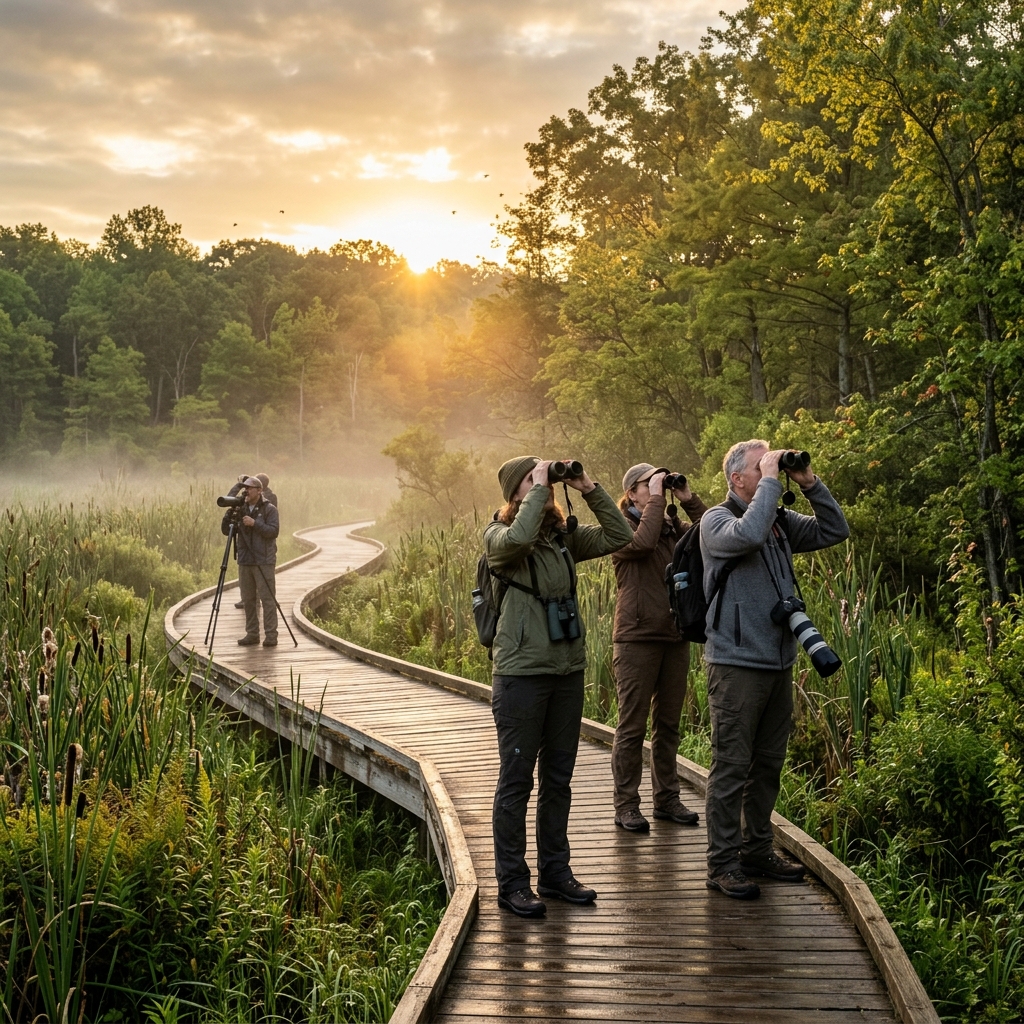
Every May, a narrow boardwalk along Lake Erie's south shore becomes the most productive birding real estate in the hemisphere. Magee Marsh's famous wooden walkway threads through willows and cottonwoods where migrating warblers rest at eye level — or below — before crossing the lake. You don't look up; you look straight ahead.
The annual Biggest Week in American Birding festival draws 100,000+ visitors from 40+ countries, with expert guides, photography workshops, and an atmosphere unlike any other in the birding world.
Where to bird:
- Magee Marsh Boardwalk — the main event; free, open at dawn
- Ottawa NWR — shorebirds, waterfowl, Northern Harrier
- Maumee Bay State Park — additional woodland and lakeshore birding
Practical tip: Arrive at first light — 5:30 AM in early May — before the crowds. The boardwalk is free. Birders here happily share scopes and identifications; the atmosphere is uniquely generous.
5. Everglades National Park, Florida — America's Subtropical Wilderness
Best time to visit: November–April (dry season) Target species: Roseate Spoonbill, Snail Kite, Wood Stork, Limpkin, Short-tailed Hawk, Purple Gallinule
The Everglades is the only subtropical wilderness in North America and the sole breeding ground for several species found nowhere else in the US. As water levels fall through winter, hundreds of thousands of wading birds concentrate at shrinking pools in numbers rarely matched on the continent.
Anhinga Trail at Royal Palm is one of the most productive 30-minute walks in American birding — anhingas, Purple Gallinule, and Tricolored Herons feed within metres of the boardwalk.
Where to bird:
- Anhinga Trail, Royal Palm — unmissable; outstanding for photography
- Eco Pond — night herons, rails at dusk
- Snake Bight Trail — flamingos and shorebirds (tide timing critical)
- Shark Valley — Snail Kite, Short-tailed Hawk, alligator spectacle
Practical tip: Flamingos have been reliably recolonizing the park since 2015 — check eBird reports at Snake Bight before you visit. Mosquitoes make summer visits brutal; the dry season is essential.
6. Point Reyes National Seashore, California — Pacific Rarity Magnet
Best time to visit: October–November for vagrant rarities; April–May for breeding seabirds Target species: Common Murre, Tufted Puffin, Marbled Murrelet, vagrant Asian species, 490+ species recorded
Point Reyes juts into the Pacific and acts as a trap for birds blown off course from Siberia, Central America, and the open ocean. In autumn, rarities appear with startling regularity — Siberian Rubythroat, Eyebrowed Thrush, Yellow-browed Warbler — drawing twitchers on cross-country flights.
Where to bird:
- Point Reyes Lighthouse — seabirds, jaegers, winter alcids
- Palomarin Field Station — banding demonstrations, migrant passerines
- Abbotts Lagoon — loons, ducks, Pacific shorebirds
- Bear Valley — California Quail, woodpeckers, Steller's Jay
Practical tip: Subscribe to the Marin County rare bird alert before your visit — arriving the morning after a rarity is discovered often means it's still present.
7. Bosque del Apache NWR, New Mexico — America's Greatest Winter Wildlife Spectacle
Best time to visit: November–early February Target species: Sandhill Crane (30,000+), Snow Goose (50,000+), Bald Eagle, Greater White-fronted Goose
Bosque del Apache is one of the most underrated wildlife spectacles in North America. Each November, tens of thousands of Greater Sandhill Cranes and Snow Geese pour into the Rio Grande valley refuge. The famous sunrise "blast-off" — when a disturbance causes 20,000 Snow Geese to take flight simultaneously — is a wall of wings, noise, and white birds against a predawn New Mexico sky that most visitors describe as the most arresting wildlife moment of their lives.
Where to bird:
- Flight Deck Observation Area — positioned for the sunrise blast-off; arrive before first light
- Tour Loop — a 15-mile driving route through crane fields, marshes, and farmland
- Chupadera Wilderness Trail — desert resident species, Crissal Thrasher, Pyrrhuloxia
Practical tip: The Festival of the Cranes (mid-November) adds guided van tours and photography workshops. Stay in Socorro — book months ahead for festival weekend.
Quick Reference: US Birding Destinations 2026
| Destination | Peak Month(s) | Signature Bird | Access |
|---|---|---|---|
| Cape May, NJ | Oct, May | Peregrine Falcon | Easy |
| High Island, TX | Late April–May | Painted Bunting | Easy |
| SE Arizona | July–Aug | Elegant Trogon | Moderate |
| Magee Marsh, OH | May 1–15 | Bay-breasted Warbler | Easy |
| Everglades, FL | Dec–Mar | Roseate Spoonbill | Easy |
| Point Reyes, CA | Oct–Nov | Tufted Puffin | Easy–Moderate |
| Bosque del Apache, NM | Nov–Jan | Sandhill Crane | Easy |
Frequently Asked Questions
What is the best birdwatching destination in the United States?
Cape May, New Jersey is consistently ranked as North America's premier birding destination for spectacle and species diversity. Southeast Arizona offers the most unique species not found elsewhere in the US, while Magee Marsh delivers the most intimate warbler experience anywhere on the continent.
When is the best time to go birdwatching in the US?
May and October are the two peak migration windows. May brings northbound migrants in full breeding plumage — the most colourful birds of the year. October concentrates raptors, sparrows, and waterfowl moving south. For winter specialties, December through February is optimal at Bosque del Apache and the Everglades.
What binoculars should I bring for US birdwatching?
For open-country locations like the Texas coast and Bosque del Apache, a 10x42 binocular with a spotting scope is ideal. For forest birding at Cape May and Magee Marsh, an 8x42 with a wide field of view performs better in low light and moving targets. See our full binoculars comparison guide for detailed advice.
Do I need a guided tour to visit these birding destinations?
All seven destinations have excellent infrastructure for independent birding. However, a guide dramatically increases your species count — especially at High Island during fallouts, in Southeast Arizona for Mexican specialties, and at Bosque del Apache for dawn timing. Most sites offer guided walks through local Audubon chapters.
How do I find rare birds at these locations?
Use eBird's Explore tool to review recent sightings before you visit. The Merlin Bird ID app identifies unfamiliar species in the field. Subscribe to your state's rare bird alert email list — in California and New Jersey especially, rarities move fast and timely reports are the difference between seeing a rarity or missing it by hours.
Find your perfect birding location next
Use our smart planner to discover the best spots matched to your experience level and the birds you want to see.