Introduction
Mastering the "Little Brown Birds"
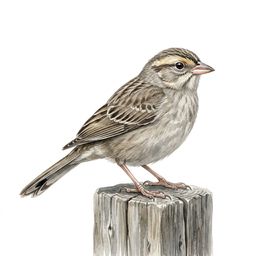
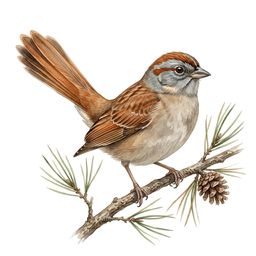
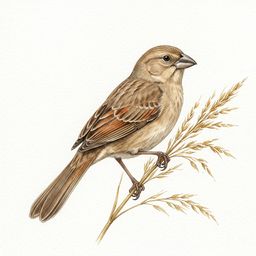
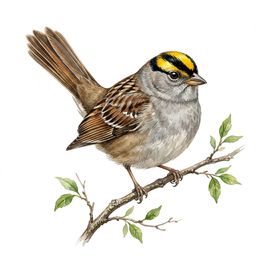
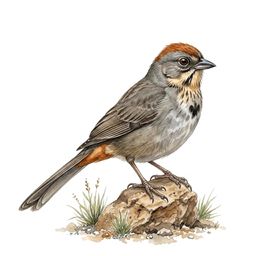
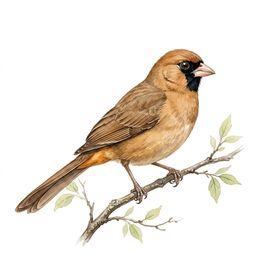
North America's sparrows (family Passerellidae) are notorious among birders as the ultimate identification challenge. With over 35 regularly occurring species — most of them brown, streaky, and ground-dwelling — telling them apart requires patience, practice, and a systematic approach. This guide covers the continent's most commonly encountered sparrows and towhees, organized by habitat and visual similarity to help you build confidence in the field.
How to use this guide: Species are grouped by ecological and visual similarity. Each entry includes key field marks, preferred habitat, range notes, and song mnemonics. Start each ID by asking two questions: (1) Is the breast streaked or plain? (2) What does the head pattern look like? These two observations will eliminate most possibilities immediately.
Sparrow Anatomy: Key Field Mark Terms
- Crown stripeCentral pale or dark stripe on head top
- Lateral crown stripeStripes flanking central crown
- SuperciliumEyebrow stripe above eye
- Eye ringPale circle around eye
- LoreArea between eye & bill
- AuricularEar patch / cheek area
- Malar stripe"Moustache" below cheek
- SubmoustachialPale stripe below malar
- Central breast spotDark spot at center of breast
- StreakingDark lines on breast/flanks
- Wing barsPale bars on coverts
- TertialsInner flight feathers
- Outer tail feathersWhite or dark — visible in flight
- Crissum / undertailFeathers beneath tail
- Conical billSeed-crushing bill shape
Breast Pattern
Streaked vs. plain is the #1 starting point. Note streak thickness, density, and whether they form a central spot.
Head Pattern
Crown stripes, eye rings, supercilium shape, and malar marks are diagnostic for most species. Study these first.
Habitat & Behavior
Many sparrows are habitat specialists. A sparrow in a salt marsh vs. a dry prairie narrows your list to 2–3 species instantly.
Species Accounts · Passerellidae
Common Backyard Sparrows
Habitat
Brushy edges, gardens, streamside thickets, marsh borders. Highly adaptable across many habitats.
Range
Year-round across most of U.S.; breeds north into Canada and Alaska.
Song
"Maids, maids, maids, put on your tea-kettle-ettle"
Both Sexes
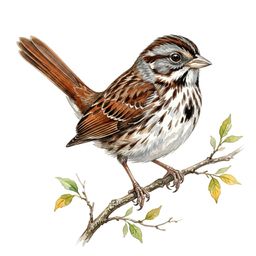
Brown and heavily streaked overall. Messy dark breast streaks converge into a CENTRAL BREAST SPOT. Gray face with brown crown. Long, rounded tail pumped in flight.
Key Mark
Central breast spot formed by converging streaks is diagnostic. Pumps tail in flight — unique among sparrows.
Variation
Highly variable — 24+ subspecies from pale desert forms to dark Pacific NW birds. Always shows breast spot.
Habitat
Forest edges, brush piles, thickets, feeders. Often in large winter flocks scratching on the ground.
Range
Breeds boreal Canada and NE U.S.; winters eastern and southern U.S.
Song
"Oh sweet Canada, Canada, Canada"
Both Sexes
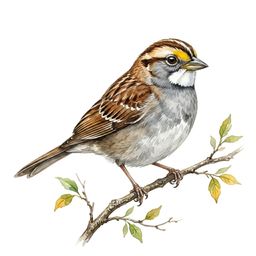
Bold black-and-white (or tan) head stripes. Bright WHITE THROAT PATCH sharply defined. Yellow lores (spot between eye and bill). Gray breast, unstreaked.
Key Mark
White throat + yellow lores + bold head stripes = unmistakable. Two color morphs: white-striped and tan-striped.
Similar
White-crowned Sparrow lacks white throat and yellow lores; has pink or orange bill.
Habitat
Brushy edges, hedgerows, lawns, parks, feeders. Breeds in alpine and arctic scrub.
Range
Breeds arctic and high mountains; winters across southern half of continent.
Song
Clear whistle then buzzy trills — varies by region
Adults
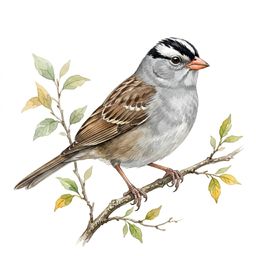
Bold black-and-white crown stripes. Clean gray breast and nape — no streaking. Pink or orange bill. Gray-brown back with streaks.
Immatures
Brown-and-tan crown stripes instead of black-and-white. Otherwise similar shape and structure. Pink bill still diagnostic.
Key Mark
Pink/orange bill + bold crown stripes + clean gray breast. No yellow lores (vs. White-throated).
Habitat
Conifer and mixed forests (breeding); gardens, feeders, roadsides, parks in winter.
Range
Breeds across Canada and mountains; winters throughout most of U.S. "Snowbird."
Song
Simple musical trill on one pitch — like a ringing bell
Key Races
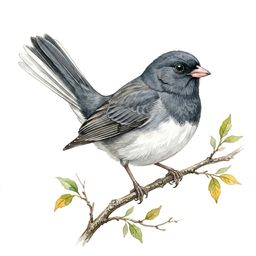
"Slate-colored" (East): dark slate-gray hood and back, white belly, pink bill. "Oregon" (West): dark hood, brown back, buffy sides.
Key Mark
WHITE OUTER TAIL FEATHERS flash conspicuously in flight — the single best field mark across all races.
Behavior
Ground feeder; hops and scratches in leaf litter. Often in flocks at feeders in winter. Pink bill diagnostic.
Species Accounts · Passerellidae
Small Spizella Sparrows
The Spizella challenge: These four small, slim sparrows share similar body shapes and can be very confusing — especially in fall and winter when breeding plumage fades. Focus on face pattern (eye ring, eyeline), bill color, and crown pattern. Habitat and song are essential in breeding season.
Habitat
Open woodlands, parks, lawns, gardens, forest edges. Very common around human habitation.
Range
Breeds across most of N. America; winters southern U.S. and Mexico.
Song
Fast, dry, mechanical trill on one pitch
Breeding
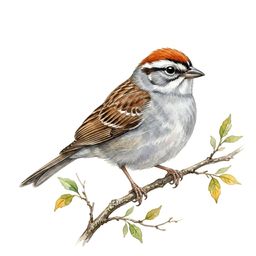
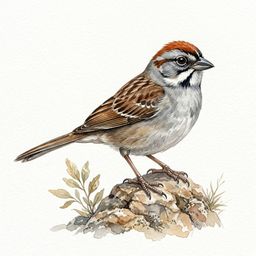
Bright RUFOUS CAP; clean white supercilium; bold black eyeline through lore. Clean gray breast unstreaked. Small black bill.
Non-breeding
Cap duller brown with streaking; face pattern muted. Dark eyeline still visible. Often confused with Clay-colored.
Key Mark
Breeding: rufous cap + black eyeline + white supercilium. All seasons: slim build, dark bill, unstreaked breast.
Habitat
Abandoned fields, brushy pastures, overgrown clearings, power-line cuts with scattered shrubs.
Range
Year-round eastern U.S.; breeds north to Great Lakes; winters SE U.S.
Song
Accelerating series of sweet whistles — like a bouncing ball
Both Sexes
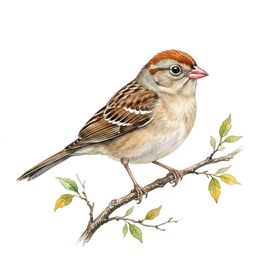
BRIGHT PINK BILL — the single best mark. Rusty crown; gray face with white eye ring (no eyeline). Two rusty wing bars. Plain buffy breast, unstreaked.
Key Mark
Pink bill + white eye ring + blank face (no eyeline) = Field Sparrow. Song is one of the most beautiful and distinctive of all sparrows.
Similar
Chipping Sparrow has dark bill and bold eyeline. American Tree Sparrow is larger with bicolored bill and breast spot.
Habitat
Weedy fields, marshes, hedgerows, feeders in winter. Breeds on subarctic tundra in willow and birch scrub.
Range
Breeds far northern Canada/Alaska; winters northern and central U.S. Arrives with cold fronts.
Song
Sweet, high, descending notes — "see-sweet, see-sweet"
Both Sexes
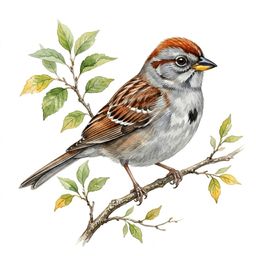
Rusty crown and eye stripe. BICOLORED BILL — dark upper, yellow lower. Gray face and breast with a single DARK CENTRAL BREAST SPOT on plain gray breast. Two white wing bars.
Key Mark
Bicolored bill (dark above, yellow below) + single dark breast spot on unstreaked breast. Larger and plumper than Chipping.
Similar
Chipping Sparrow is smaller with all-dark bill and no breast spot. Field Sparrow has pink bill.
Habitat
Brushy prairie, shrubby fields, Christmas tree farms, jack pine barrens.
Range
Breeds Great Plains and Great Lakes; migrates through central U.S.; winters Mexico.
Song
2–5 flat, insect-like buzzes — "bzz bzz bzz"
Both Sexes
Pale overall with sharply outlined brown AURICULAR (ear) PATCH bordered by dark lines. Gray nape. White central crown stripe bordered by dark lateral crown stripes.
Key Mark
Well-defined brown cheek patch with crisp dark borders is diagnostic. Clean gray nape contrasts with brown back.
Similar
Non-breeding Chipping has less defined cheek patch and darker lores. Brewer's Sparrow is plainer with no sharp cheek borders.
Species Accounts · Passerellidae
Open-Country & Prairie Sparrows
Habitat
Sagebrush steppe and dry scrublands. The quintessential sagebrush bird of the American West.
Range
Breeds western U.S. and SW Canada in sagebrush; winters SW U.S. and Mexico.
Song
Long, complex, canary-like series of trills and buzzes
Both Sexes
The PLAINEST Spizella — overall pale grayish-brown with fine streaking on crown. Thin white eye ring. No bold markings. Small dark bill.
Key Mark
Extremely plain face — no bold eyeline, no cheek patch borders. Thin eye ring + streaked crown + sagebrush habitat = Brewer's.
Similar
Clay-colored has sharply bordered cheek patch. Chipping has bold eyeline. Non-breeding Chipping is the trickiest comparison.
Habitat
Dry open fields, pastures, prairies, roadsides, agricultural edges. Perches on fence posts.
Range
Breeds across northern U.S. and southern Canada; winters southern U.S. and Mexico.
Song
Two low whistles, two high notes, descending trill — sings at dusk
Both Sexes
Streaky brown above and on breast. Thin white eye ring. WHITE OUTER TAIL FEATHERS flash in flight. Chestnut lesser coverts (shoulder patch — often hidden).
Key Mark
White outer tail feathers + eye ring + open-country habitat. Named for its habit of singing at vespers (dusk).
Similar
Savannah Sparrow lacks white outer tail and has yellow lores. Song Sparrow has rounder tail without white edges.
Habitat
Open country with scattered trees, grasslands, farmland edges, sandy roadsides, oak savanna.
Range
Breeds central and western U.S.; winters SW U.S., Mexico, Central America.
Song
Complex jumble of whistles, buzzes, trills, and churrs
Both Sexes
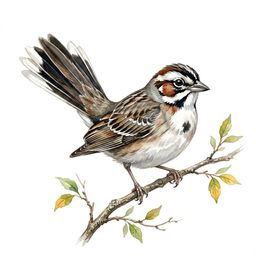
BOLD HARLEQUIN FACE PATTERN — chestnut, black, and white stripes on head. Clear white breast with single dark CENTRAL SPOT. Long rounded tail with large white corners.
Key Mark
Unmistakable face pattern. White tail corners in flight. Central breast spot on otherwise plain breast. One of the easiest sparrows to identify.
Habitat
Short-grass prairies, sagebrush plains, agricultural fields. State bird of Colorado.
Range
Breeds Great Plains from S. Canada to N. Texas; winters SW U.S. and Mexico.
Song
Exuberant whistles and trills in "skylarking" display flight
Breeding Male
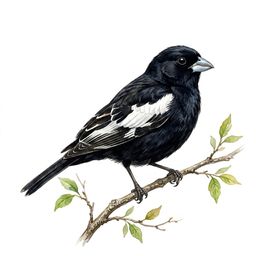
ALL BLACK with bold WHITE WING PATCHES — unmistakable. Heavy pale blue-gray bill. Stocky, short-tailed build.
Female / Non-breeding
Chunky, streaked brown sparrow with heavy pale bill. Shows white or buffy wing patch (smaller than breeding male). Often in large flocks.
Key Mark
Breeding male: all black + white wing patches. All plumages: chunky build + heavy pale bill + wing patch.
Species Accounts · Passerellidae
Grassland Sparrows
The grassland challenge: These sparrows are secretive, rarely perch high, and flush at your feet only to drop back into grass 20 feet away. Learning their insect-like songs is often the only way to detect them. Many are declining due to habitat loss — pay attention to grassland conservation efforts.
Habitat
Open grasslands, meadows, agricultural fields, tundra edges, salt marshes, dunes. Very widespread.
Range
Breeds across Canada and northern U.S.; winters southern U.S. and Mexico.
Song
"tsip-tsip-tsip-tseee-tsaaay" — buzzy ending
Both Sexes
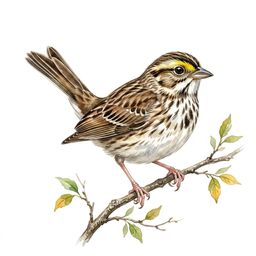
Heavily streaked breast and flanks. YELLOW LORES (pale spot above eye). Short notched tail. Pink legs. Pale median crown stripe.
Key Mark
Yellow lores + short notched tail + streaky breast. No white outer tail feathers (vs. Vesper). The "default" grassland sparrow.
Variation
17+ subspecies vary in darkness and streak intensity. "Ipswich" race (Sable Island) is large and pale — winters on Atlantic dunes.
Habitat
Dry grasslands, prairies, hayfields, pastures with sparse vegetation. Avoids tall, dense grass.
Range
Breeds across central and eastern U.S.; winters southern U.S. and Caribbean. Declining significantly.
Song
"sip-sip, tuzzzzzzzz" — insect-like grasshopper buzz
Both Sexes
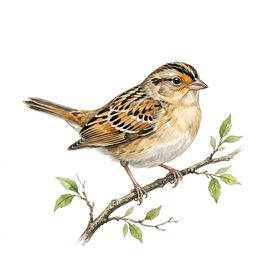
FLAT HEAD profile with large bill. PLAIN BUFFY BREAST — unstreaked (key difference from Savannah). Yellow-orange spot at lores. Beady dark eye on plain face.
Key Mark
Unstreaked buffy breast + flat head + yellow lore spot + insect-like song. Short tail barely visible in grass.
Similar
Savannah Sparrow has streaked breast. Henslow's has olive-green head and is streaked below.
Habitat
Tall, dense grasslands with thick thatch layer. Very specific habitat requirements; declining rapidly.
Range
Breeds NE and NC U.S.; winters SE U.S. in pine savannas. Local and declining throughout.
Song
"tse-lik" — a tiny, pathetic hiccup; shortest sparrow song
Both Sexes
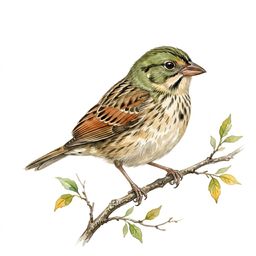
OLIVE-GREEN HEAD and nape — unique among sparrows. Dark moustache streaks. Fine black streaking on buffy breast. Rufous wings. Large flat head.
Key Mark
Olive-green head + dark malar streaks + rufous wings. Song is unmistakable — just a sharp "tse-lik" hiccup.
Behavior
Extremely skulking; rarely flushes. Runs through grass like a mouse. Often detected only by song.
Habitat
Native mixed-grass prairie in excellent condition. Very specific habitat requirements; does not use cropland.
Range
Breeds northern Great Plains (Dakotas, Montana, S. Canada); winters SW U.S. and N. Mexico.
Song
2–3 high chips then a musical trill — "zip-zip-zrrrrr"
Both Sexes
Warm ochre or orange-buff on face and crown. BROAD OCHRE MEDIAN CROWN STRIPE. Thin dark necklace of streaks across upper breast. Two thin white wing bars.
Key Mark
Ochre central crown stripe + necklace of fine breast streaks + native prairie habitat. Flat head profile.
Similar
Savannah Sparrow has yellow lores and heavier streaking. Grasshopper has unstreaked breast.
Species Accounts · Passerellidae
Streaked Brown Sparrows
Melospiza trio: Song, Lincoln's, and Swamp Sparrows are closely related and often found in similar habitats. The key: Song has messy, blotchy streaks converging to a central spot; Lincoln's has fine, crisp streaks on a buffy wash; Swamp has a rusty cap with gray face and mostly unstreaked breast.
Habitat
Freshwater marshes, cattail edges, wet meadows, bogs, swampy thickets. Almost always near water.
Range
Breeds NE U.S. and Canada; winters eastern U.S. and Gulf Coast.
Song
Slow, sweet, musical trill — looser than Chipping Sparrow
Adults
RUFOUS CAP; gray face and breast (mostly unstreaked or faintly streaked). Dark back with rufous tones. White throat. Gray supercilium.
Key Mark
Rusty cap + gray face + unstreaked breast + marsh habitat. The darkest and richest-colored Melospiza.
Similar
Song Sparrow has heavy breast streaking. Chipping Sparrow has eyeline and avoids marshes. Lincoln's has fine streaks on buffy breast.
Habitat
Dense wet thickets, willow bogs, alder edges. Extremely skulking; prefers dense low cover.
Range
Breeds boreal Canada and western mountains; migrates widely; winters southern U.S. to Central America.
Song
Sweet, jumbling, wren-like warble that rises then drops
Both Sexes
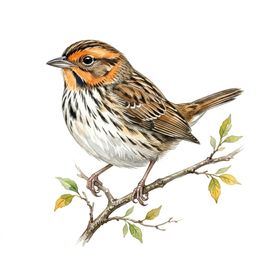
FINE, CRISP black streaks on a BUFFY BREAST BAND — the key mark. Gray face with buffy submoustachial stripe. Gray supercilium. Thin eye ring.
Key Mark
Buffy breast with fine, crisp streaks (vs. Song Sparrow's messy, blotchy streaks). Dainty and shy — skulks more than Song.
Behavior
Very secretive; raises crown feathers when alarmed. Often overlooked. Responds well to pishing in migration.
Habitat
Dense thickets, brush piles, forest undergrowth. Forages noisily by DOUBLE-SCRATCHING — kicking backward with both feet.
Range
Breeds boreal forests and western mountains; winters across U.S. in brushy areas.
Song
Beautiful clear whistles followed by trills — rich and lively
Subspecies Groups
"Red" (East): bright rusty-red overall. "Sooty" (Pacific NW): dark chocolate-brown. "Slate-colored" (interior West): gray-headed. "Thick-billed" (Sierra): large gray bill.
Key Mark
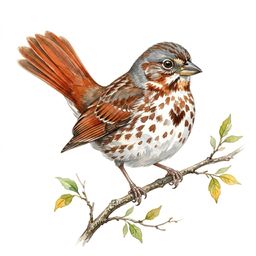
LARGE and chunky — biggest common sparrow. Triangular chevron-shaped breast spots. Reddish tail in most forms. Vigorous double-scratch foraging.
Habitat
Brushy fields, hedgerows, woodland edges in winter. Breeds at northern treeline in stunted boreal forest.
Range
Breeds N. central Canada; winters Great Plains from Nebraska to Texas. Narrow range.
Song
Clear, melancholy whistles on 1–2 pitches — haunting
Adults
LARGEST Zonotrichia. BLACK CROWN, FACE, and THROAT contrasting with gray cheeks and white belly. Pink bill. Two white wing bars.
Immatures
Less black — buffy face and crown with variable dark throat patch. Still large with pink bill. Often mixed with White-crowned flocks.
Key Mark
Large size + black bib/crown + pink bill. The only sparrow with a solid black face and throat in adult plumage.
Species Accounts · Passerellidae
Marsh & Coastal Sparrows
The Ammospiza group: These are perhaps the most challenging sparrows in North America. All share orange or buffy face patterns and inhabit dense wetland vegetation. Habitat type (fresh vs. salt marsh), face pattern details, and range are critical for separating them. Songs are thin, wheezy, and insect-like.
Habitat
Wet meadows, sedge marshes, damp grasslands with dense low cover. Very skulking.
Range
Breeds N. Great Plains and Canada; winters Gulf Coast and SE U.S. in dense grassy marshes.
Song
Extremely thin, high insect-like hiss — barely audible
Both Sexes
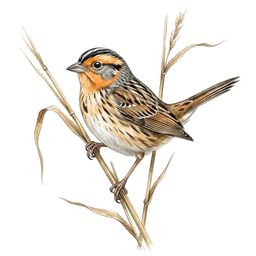
BRIGHT ORANGE-BUFF SUPERCILIUM and breast band. Gray ear patch. FINELY STREAKED GRAY NAPE — diagnostic. White central crown stripe. Crisp streaks on flanks.
Key Mark
Gray streaked nape + orange eyebrow + gray ear patch. The most colorful of the marsh sparrows.
Similar
Nelson's has plain (unstreaked) gray nape. Grasshopper is in drier habitat with unstreaked breast.
Habitat
Coastal salt marshes and interior freshwater marshes. Interior birds breed in wet prairies.
Range
Three populations: interior prairies (summer), James/Hudson Bay (summer), Atlantic coast (winter). Limited range.
Song
"p-tsssssshhhuk" — wheezy, hissing buzz
Both Sexes
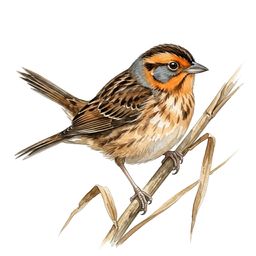
Bright ORANGE TRIANGLE on face surrounding gray ear patch. PLAIN GRAY NAPE (unstreaked — key vs. LeConte's). Buffy, lightly streaked breast.
Key Mark
Orange face + gray ear patch + unstreaked gray nape. Formerly "Sharp-tailed Sparrow" (split from Saltmarsh).
Similar
LeConte's has streaked nape. Saltmarsh is brighter on head but grayer below with sharper streaks.
Habitat
EXCLUSIVELY coastal salt marshes. The most habitat-restricted North American sparrow.
Range
Atlantic coast from Maine to Virginia. Year-round in core range; some shift south in winter. Endangered.
Song
Weak, whispery, raspy buzz — similar to Nelson's
Both Sexes
Brighter orange-buff head than Nelson's. White breast with SHARP, CRISP dark streaks (vs. Nelson's blurry streaks). Gray ear patch. Pointed tail feathers.
Key Mark
Crisp breast streaks (not blurry) + bright head + salt marsh habitat. Overlaps with Nelson's only on Atlantic coast.
Conservation
Among the most endangered songbirds in North America. Threatened by sea-level rise flooding nests.
Habitat
Coastal salt marshes — almost never leaves marsh habitat. Walks on mud and climbs marsh grass stems.
Range
Atlantic and Gulf coasts from Massachusetts to Texas. Year-round in most of range.
Song
Loud, raspy, buzzy song — like a Red-winged Blackbird's
Both Sexes
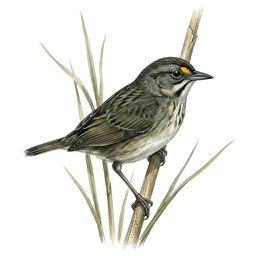
LARGEST Ammospiza — stocky with long bill. Overall dark grayish-brown. YELLOW LORE SPOT. Dark malar stripe. White throat with faint streaking.
Key Mark
Large, dark, long-billed + yellow lores + salt marsh habitat. Much darker and larger than Nelson's or Saltmarsh.
Subspecies
Gulf coast "Cape Sable" race (now extinct or nearly so) was distinctive. Atlantic birds somewhat variable in darkness.
Species Accounts · Passerellidae
Desert & Arid-Land Sparrows
Habitat
Arid desert scrub — creosote, cactus, rocky hillsides, desert washes. A true desert specialist.
Range
Year-round in SW U.S. deserts from S. California to W. Texas; winters into N. Mexico.
Song
Two clear tinkling whistles then a trill — sweet and metallic
Adults
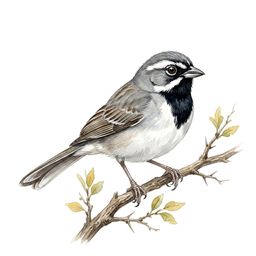
Striking BLACK THROAT and BIB. Two bold WHITE FACE STRIPES (supercilium and malar). Clean gray breast. Gray-brown upperparts.
Immatures
Lack black throat — have faint streaking instead. Still show bold white face stripes. Gray overall.
Key Mark
One of the most striking sparrows — black throat + white face stripes + desert habitat = unmistakable adult.
Habitat
Steep brushy hillsides with chaparral, dense scrub oak, and manzanita. Shy and often overlooked.
Range
Breeds scattered locations in SW U.S. (California, Arizona, New Mexico, W. Texas); winters Mexico.
Song
Sweet, accelerating series of notes ending in a trill
Breeding Male
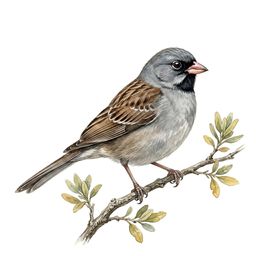
Gray head with small BLACK CHIN PATCH that blends into gray breast. Pink bill. Rusty-brown back and wings. No wing bars.
Female / Non-breeding
Gray overall with brown back; lacks black chin. Very plain face. Pink bill is best mark year-round.
Key Mark
Gray plumage + pink bill + brushy hillside habitat. Breeding male's black chin is diagnostic but hard to see at distance.
Habitat
Dense chaparral and coastal sage scrub (California populations); sagebrush (interior populations).
Range
California coast, Great Basin sagebrush. Year-round in California; interior birds migrate south.
Song
Rapid, tinkling series of notes rising and falling
Both Sexes
Gray head and breast. DARK MALAR STRIPE contrasting with white throat. Dark central breast spot (variable). Dark back with brown streaks.
Key Mark
Dark malar + white throat + central breast spot + chaparral/sage habitat. Formerly part of "Sage Sparrow."
Similar
Sagebrush Sparrow (now split) is paler with fainter malar. Black-throated Sparrow has white face stripes.
Habitat
Rocky, brushy hillsides with scattered grass. Open oak woodlands, desert canyons with boulders.
Range
Year-round in SW U.S. from California to Oklahoma and Texas. Sedentary — rarely wanders.
Song
Jumbled, rapid series of chips — like a House Wren
Both Sexes
RUFOUS CROWN. Gray face with dark eyeline. Single dark MALAR STRIPE on white throat. Plain gray breast — unstreaked. Gray-brown upperparts.
Key Mark
Rusty crown + dark eyeline + single malar stripe + rocky hillside habitat. Plain breast separates from streaked sparrows.
Similar
Chipping Sparrow has bold white supercilium and no malar stripe. Found in different (flatter) habitat.
Species Accounts · Passerellidae
Southern & Specialty Sparrows
Habitat
Dry grasslands with scattered shrubs, yucca, mesquite, or prickly pear. Desert grassland specialist.
Range
Breeds S. Great Plains from Kansas to Mexico; winters S. Texas and Mexico. Nomadic — follows rainfall.
Song
Sweet whistles and trills in "SKYLARKING" flight — rises, flutters, glides down
Both Sexes
Plain grayish-brown with fine streaking on crown and back. Dull white eye ring. Underparts plain grayish-white. Relatively large and long-tailed.
Key Mark
Best identified by SKYLARKING DISPLAY — male flutters up 20–30 feet singing, then parachutes down. Plumage is nondescript.
Similar
Brewer's Sparrow is smaller with streaked crown. Botteri's is warmer brown with different song.
Habitat
Mature open pine woodlands with grassy understory maintained by fire. Needs fire-managed forests.
Range
SE U.S. from Virginia to Texas. Year-round but very local. Declining due to fire suppression.
Song
Beautiful clear whistle followed by trills — like a Hermit Thrush
Both Sexes
Reddish-brown above with dark back streaks. RUFOUS CROWN and eyeline. Plain gray-buff breast — unstreaked. Long rounded tail. Flat head profile.
Key Mark
Pine woods + unstreaked breast + rufous crown + beautiful song. Extremely skulking — often heard, rarely seen.
Conservation
Dependent on prescribed fire management. Where fire is suppressed, undergrowth becomes too dense and Bachman's disappears.
Habitat
Tall grasslands, sacaton flats, and coastal prairies. Desert grassland with tall bunch grasses.
Range
SE Arizona and S. Texas (summer); mainly Mexico year-round. Very limited U.S. range.
Song
Accelerating chips then a trill — bouncing-ball pattern
Both Sexes
Warm brown above; plain grayish-buff below. Long rounded tail. Large bill. Very nondescript plumage — nearly featureless face.
Key Mark
Warm brown tones + plain breast + tall grass habitat + limited range. Song is most reliable ID. Very similar to Cassin's in appearance.
Similar
Cassin's Sparrow skylarks and is grayer. Bachman's is in pine woods (different habitat entirely).
Habitat
Dense brush, forest edges, parks, gardens (winter). Breeds in alpine and subarctic scrub near treeline.
Range
Breeds Alaska and W. Canada; winters Pacific coast from BC to Baja California.
Song
"No gold here" or "I'm so tired" — sad, minor-key 3-note whistle
Adults
GOLDEN CROWN PATCH surrounded by bold black lateral crown stripes. Gray face and breast. Brownish back with streaks. Dark bill.
Immatures
Crown duller — brownish-gold with less defined black. Otherwise similar body pattern. Often mixed with White-crowned flocks.
Key Mark
Gold crown + black crown stripes + dark bill. Song is hauntingly beautiful and unmistakable. Pacific coast only in winter.
Species Accounts · Towhees
Towhees — The "Big Sparrows"
Towhees are large, ground-dwelling members of family Passerellidae. All share a distinctive "double-scratch" foraging style — jumping forward and kicking backward with both feet to uncover food in leaf litter. If you hear vigorous rustling in the underbrush, it's probably a towhee. Listen for their loud, distinctive songs and calls.
Habitat
Brushy forest edges, thickets, overgrown fields, hedgerows, woodland understory.
Range
Year-round eastern U.S.; breeds north to southern Canada; winters SE U.S.
Song
"Drink your teeeee!" — clear and emphatic
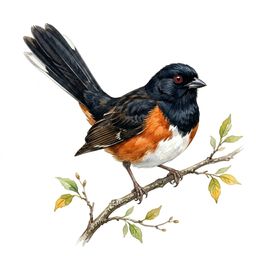
Male
BLACK hood, back, and tail. RUFOUS SIDES. White belly. White tail corners. Red eye (most populations).
Female
Same pattern but BROWN replaces black. Rich chocolate-brown hood and back. Rufous sides. White belly.
Key Mark
Bold tricolored pattern (black/brown + rufous + white). Call is a loud, rising "chewink!" — namesake call.
Habitat
Dry thickets, chaparral, brushy forest edges, parks, gardens. The western counterpart of Eastern.
Range
Year-round western U.S.; breeds into S. Canada; some winter movement south.
Song
Buzzy trill (variable); whiny, cat-like "meew" call
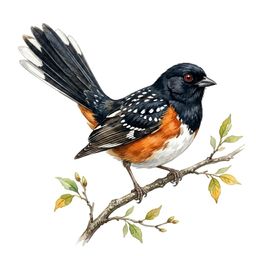
Male
Like Eastern but with bold WHITE SPOTS on wings and back. Black hood, rufous sides, white belly. Red eye.
Female
Dark brown (not black) with white wing spots. Rufous sides. Otherwise similar pattern to male.
Key Mark
White spots on wings/back separate from Eastern. Formerly "Rufous-sided Towhee" with Eastern. Hybridize where ranges meet.
Habitat
Montane shrublands, sagebrush, manzanita, pinyon-juniper scrub. High-elevation brushy slopes.
Range
Breeds mountains of western U.S.; winters SW U.S. and Mexico in dense brush.
Song
Lively, slurred notes and trills; cat-like "meew" call
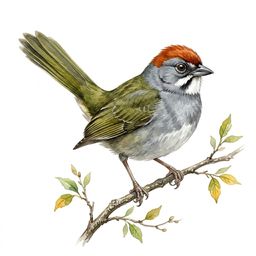
Both Sexes
OLIVE-GREEN wings, back, and tail — unique. RUFOUS CROWN. Gray face and breast. WHITE THROAT sharply defined against gray.
Key Mark
Green + rufous cap + white throat = unmistakable. The most colorful towhee. Skulks in dense brush but responds to pishing.
Similar
No other towhee or sparrow is olive-green. Chipping Sparrow has rufous cap but is much smaller and lacks green.
Habitat
Chaparral, coastal scrub, suburban gardens, parks. Very common in California backyards.
Range
Year-round in California and SW Oregon coast. Very sedentary — rarely moves far.
Song
Accelerating metallic "chink chink chink-chink-chinkchink"
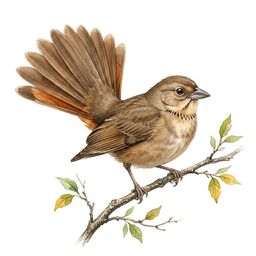
Both Sexes
Uniformly dull brown overall — the "plainest" towhee. RUSTY CRISSUM (undertail coverts). Buffy throat with faint necklace of streaks. Dark eyes.
Key Mark
All-brown bird + rusty undertail + California range. Pairs often perform squealing duets year-round.
Similar
Canyon Towhee is paler with dark breast spot (different range — no overlap). Abert's has black face mask.
Species Accounts · Towhees
Brown Towhees & Continued
Habitat
Desert foothills, rocky canyons, dry brushy areas, mesquite, juniper woodland edges.
Range
Year-round from Arizona and New Mexico east to W. Texas and south into Mexico.
Song
Musical, jumbled series of chips — "jingle" pattern
Both Sexes
Pale grayish-brown overall (paler than California). DARK CENTRAL BREAST SPOT. Buffy eye ring. Reddish crown (subtle). Buffy throat with fine necklace.
Key Mark
Central breast spot + buffy eye ring + SW desert habitat. Formerly combined with California as "Brown Towhee." Ranges do not overlap.
Habitat
Dense riparian brush along desert streams, mesquite bosques, irrigated agricultural edges.
Range
Very restricted — S. Arizona, extreme SE California, SW New Mexico. Year-round and sedentary.
Song
Rapid series of bell-like, ringing notes
Both Sexes
Sandy brown overall. Distinctive BLACK FACE MASK around bill — unique among towhees. Pale bill. Rusty undertail coverts. No breast spot.
Key Mark
Black face mask = instant ID. The only towhee with a prominent dark mask. Found only in desert riparian corridors.
Identification Strategy: The Two-Question Method
Step 1: Breast Pattern
Streaked? → Song, Savannah, Lincoln's, Fox, Nelson's, Saltmarsh, Vesper, Baird's
Central spot only? → American Tree, Lark, Canyon Towhee
Plain / unstreaked? → Chipping, Field, Clay-colored, Brewer's, Swamp, Grasshopper, all Towhees, Dark-eyed Junco
Step 2: Head Pattern
Bold crown stripes? → White-crowned, White-throated, Golden-crowned, Harris's
Rufous cap? → Chipping, Swamp, American Tree, Rufous-crowned, Field
Plain / nondescript? → Brewer's, Cassin's, Bachman's, Botteri's, California Towhee
Step 3: Habitat
Salt marsh? → Seaside, Saltmarsh, Nelson's
Dry prairie? → Grasshopper, Baird's, Lark Bunting, Vesper
Desert scrub? → Black-throated, Bell's, Rufous-crowned
Backyard / feeder? → Song, White-throated, Junco, House
Step 4: Bill Color
Pink bill? → Field, White-crowned, Junco, Harris's, Black-chinned
Bicolored (dark/yellow)? → American Tree
Heavy pale bill? → Lark Bunting, Fox (Thick-billed race)
All dark bill? → Most other sparrows
Quick Reference (continued)
At-a-Glance Identification Table (cont.)
| Species | Breast | Key Mark | Habitat | Song Hint |
|---|
| Fox Sparrow | Chevron spots | Large; double-scratch; red tail | Dense thickets | Clear lively whistles |
| Harris's | Plain white | Black crown/throat; pink bill | Brushy fields (winter) | Melancholy whistles |
| Golden-crowned | Plain gray | Gold crown; dark bill | Dense brush (Pacific) | "No gold here" |
| LeConte's | Streaked flanks | Orange eyebrow; streaked nape | Wet meadows | Thin insect hiss |
| Nelson's | Blurry streaks | Orange face; plain gray nape | Salt/fresh marsh | Wheezy buzz |
| Saltmarsh | Crisp streaks | Bright head; sharp streaks | Coastal salt marsh | Whispery rasp |
| Seaside | Faintly streaked | Large, dark; yellow lores | Salt marsh | Loud raspy buzz |
| Black-throated | Plain | Black throat; white face stripes | Desert scrub | Tinkling whistles |
| Black-chinned | Plain gray | Pink bill; black chin (♂) | Brushy hillsides | Accelerating notes |
| Bell's | Central spot | Dark malar; white throat | Chaparral, sage | Tinkling series |
| Rufous-crowned | Plain | Rufous crown; single malar | Rocky hillsides | Rapid jumbled chips |
| Cassin's | Plain | Skylarking display; plain | Dry grassland, yucca | Skylarking whistles |
| Bachman's | Plain buff | Rufous crown; pine woods | Open pine forest | Thrush-like whistle |
| Botteri's | Plain buff | Warm brown; tall grass | Desert grassland | Bouncing-ball chips |
| Eastern Towhee | White belly | Black/brown + rufous sides | Forest edges, thickets | "Drink your teeeee" |
| Spotted Towhee | White belly | White wing spots; rufous sides | Dry thickets (West) | Buzzy trill; mew call |
| Green-tailed | Plain gray | Green wings; rufous crown | Mountain shrublands | Slurred notes; mew |
| California Towhee | Plain brown | All brown; rusty undertail | Chaparral, gardens | Metallic chinks |
| Canyon Towhee | Central spot | Pale brown; breast spot | Desert foothills | Musical jingle |
| Abert's Towhee | Plain sandy | BLACK FACE MASK | Desert riparian | Bell-like notes |
Remember: Habitat narrows your options dramatically. A streaked sparrow in a salt marsh = Nelson's, Saltmarsh, or Seaside. A streaked sparrow in a dry prairie = Savannah, Vesper, or Baird's. A plain sparrow with a rufous cap near water = Swamp. Use habitat as your first filter, then check breast and head patterns.

SPARROW ID
POCKET REFERENCE
36 species of North American sparrows and towhees
Factual field marks · Song mnemonics · Habitat cues
Range notes · Confusion species · ID strategy
Quick-reference tables for field use
Data sourced from Cornell Lab of Ornithology, National Audubon Society,
and peer-reviewed ornithological literature.
© 2025 AvianScope · avianscope.com · All rights reserved.